Compressed air line from multilayer pipe
A fixed compressed air line in your garage or workshop is quick and neat to make from multilayer pipe with press fittings: no soldering, no threading and no more hoses across the floor. It only works with a system the manufacturer specifies for compressed air, and the air has to be oil-free.
 Free shipping · ships within 24 h · invoice by email
In short
- It is allowed with a multilayer system that lists compressed air as an application, such as Henco or Pipetec (TH profile).
- Oil-free: compressor oil attacks the rubber ring in the fitting. Use an oil-free compressor or an oil filter.
- Maximum 10 bar in the line. Set your compressor or pressure regulator to that.
- Pressing is done with the same press jaw as for water: TH16, TH20, TH26 or TH32.
Which systems are allowed for compressed air?
| System | Compressed air | Condition | Profile |
|---|---|---|---|
| Henco multilayer pipe | yes | oil-free, with active oil filter, max 10 bar | TH |
| Pipetec | yes | oil-free compressed air up to 10 bar | TH |
| Viega Sanfix Fosta | yes | according to Viega | VP (own) |
| Uponor Uni Pipe PLUS | no | excluded by Uponor | UP |
| Copper or stainless (e.g. Viega Profipress) | yes | standard EPDM ring with oil-free air | V / M |
Why oil-free?
A press fitting contains a rubber O-ring, usually made of EPDM. It is made for water and air, not for oil. A compressor with oil always blows out a little oil mist, and that can make the ring swell or start leaking. That is why Henco only specifies compressed air for oil-free installations with an active oil filter. If you have a compressor with oil, fit an oil or carbon filter after it, before the line starts.
How to lay it
- Set the pressure in the line to a maximum of 10 bar, with the pressure switch of the compressor or a pressure regulator.
- Connect the compressor with a short piece of flexible hose. It absorbs vibrations and the air cools down a little before it enters the pipe.
- Lay the line with a slight slope, with a drain valve at the lowest point. That way the condensate runs off.
- Take branches to an outlet from the top of the line (gooseneck), so less water ends up in your hose and tools.
- For a garage or hobby workshop 20 mm is usually enough; for a long line or tools that use a lot of air, take 26 mm.
- Cut the pipe square, deburr and calibrate it, and push it into the fitting up to the mark before you press.
- After pressing, put the line under pressure and check all joints with soapy water.
The press jaw to go with it
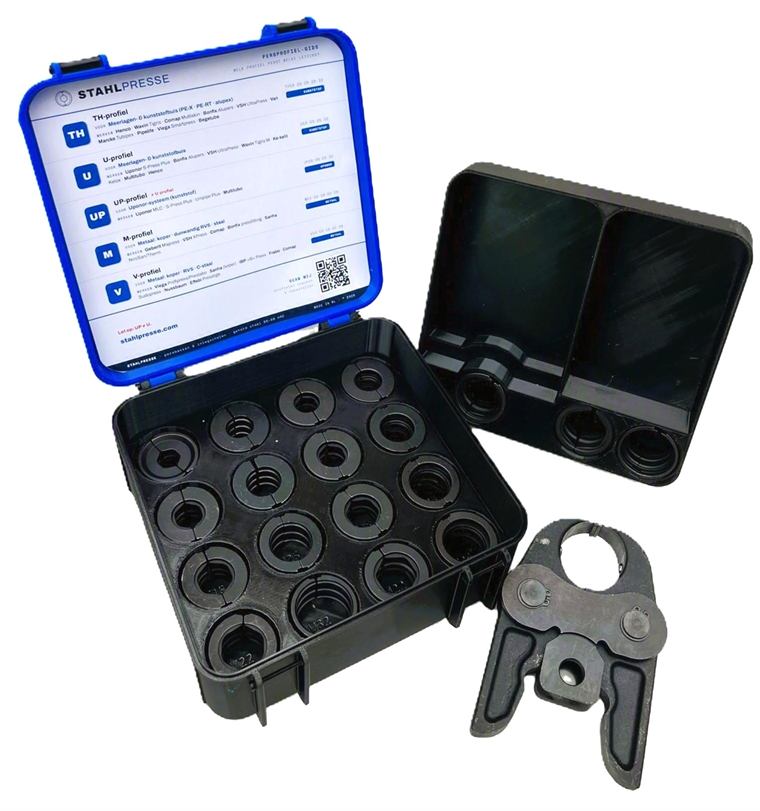
Every set has 1 press jaw and 19 inserts with TH, V, U and M, up to 32 mm multilayer and 28 mm copper. TH16, TH20, TH26 and TH32 are included, so you can press Henco and Pipetec with it. Standard (32 kN) €345, Compact (19 kN) €345, Standard Mini (15 kN) €395, UP profile €50 extra. Free shipping in the EU.
Check your fitting
Choose the brand and system of your fitting and you see right away which profile you need.
Frequently asked questions
Read more
Which press profile do I need? →
TH profile: which fittings? →
Which press fittings to choose? →
Which press tool to buy? →

